

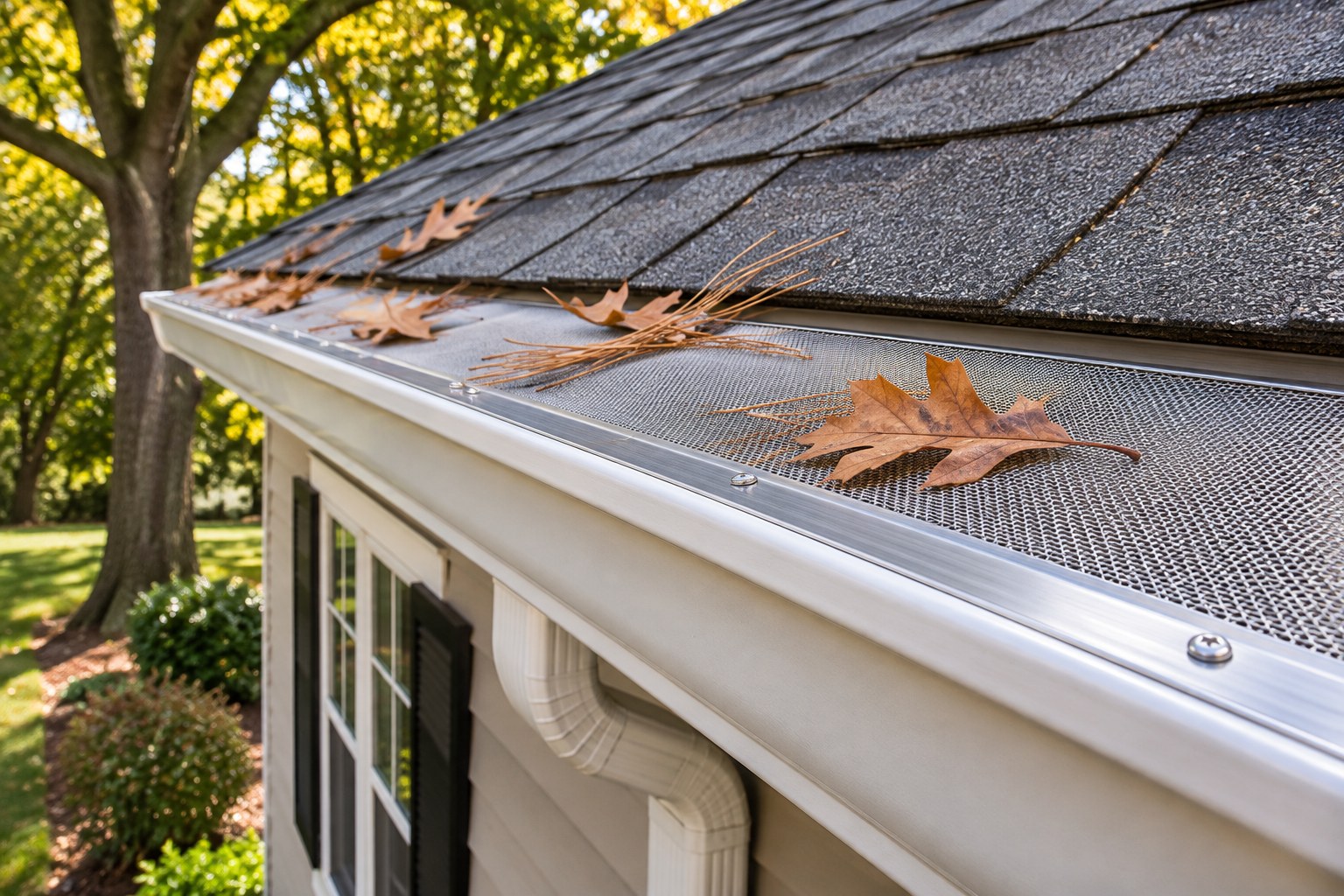
Are gutter guards worth it? For most homes with mature trees overhead, yes: guards block most leaves and debris, cut the number of ladder climbs, and protect the fascia and foundation from overflow. For homes with few overhanging trees, or gutters that already sag, the upfront cost is harder to justify.
Guards reduce gutter maintenance, but they never end it, and the wrong type can make clogs worse. This guide covers what guards cost, how each type performs, the best option for pine needles and oak leaves, and the installation mistakes that turn a good investment into a bad one.
Are Gutter Guards Worth It for Your Home?
Gutter guards are worth it when your roof sits under heavy tree cover, your gutters clog more than twice a year, or climbing a ladder is a real risk for you. They are not worth it when trees are minimal, when you expect a maintenance-free system, or when the gutters underneath are damaged.
| Your Situation | Usually Worth It? | Why |
|---|---|---|
| Mature oak, maple, or pine over the roof | Yes | Frequent clogs make recurring cleaning the bigger cost |
| Two or more gutter cleanings a year | Yes | Guards cut cleaning frequency and ladder time |
| Few or no overhanging trees | Rarely | Little debris means little to block |
| Sagging, rusted, or poorly sloped gutters | Not yet | Fix or replace the gutters first |
| Expecting zero maintenance | No | Every guard still needs periodic rinsing |
When Gutter Guards Pay Off
- Leaves, needles, or seed pods fill your gutters every season
- Overflow has already stained siding or rotted fascia boards
- The roof is steep, tall, or hard to reach safely
- You would otherwise pay for several professional cleanings a year
When Gutter Guards Are Not Worth the Cost
- Your roofline is mostly clear of trees
- Your gutters are aging, sagging, or leaking at the seams
- You plan to skip inspections after installation
How Much Do Gutter Guards Cost?
Gutter guard cost depends on the guard type, total gutter length, roof height, and whether a pro installs it. According to Angi, materials run about $1 to $10 per linear foot, professional installation adds about $9 per linear foot on average, and most homes have 150 to 250 linear feet of gutter.
Are Gutter Guards Worth It? Cost Versus Cleaning
The math is a trade-off between one larger upfront expense and a recurring cleaning bill. Heavy tree cover can mean two to four cleanings a year, so over the life of a quality guard the total often favors the guard. Light tree cover flips that math.
The bigger number is usually avoided damage. A clogged gutter overflows, and overflow can rot fascia boards, soak soil beside the foundation, and send water into a crawlspace or basement. Repairing that damage costs far more than preventing it.
| Cost Factor | How It Changes the Price |
|---|---|
| Guard type | Foam and screens cost least, micro-mesh and surface-tension cost most |
| Total gutter length | Longer runs cost more overall but less per foot |
| Roof height and pitch | Taller or steeper roofs raise labor |
| Gutter condition | Repairs or replacement add to the total |
| DIY or professional install | Pro installation adds labor but improves fit and pitch |
How Much Water Your Gutters Handle
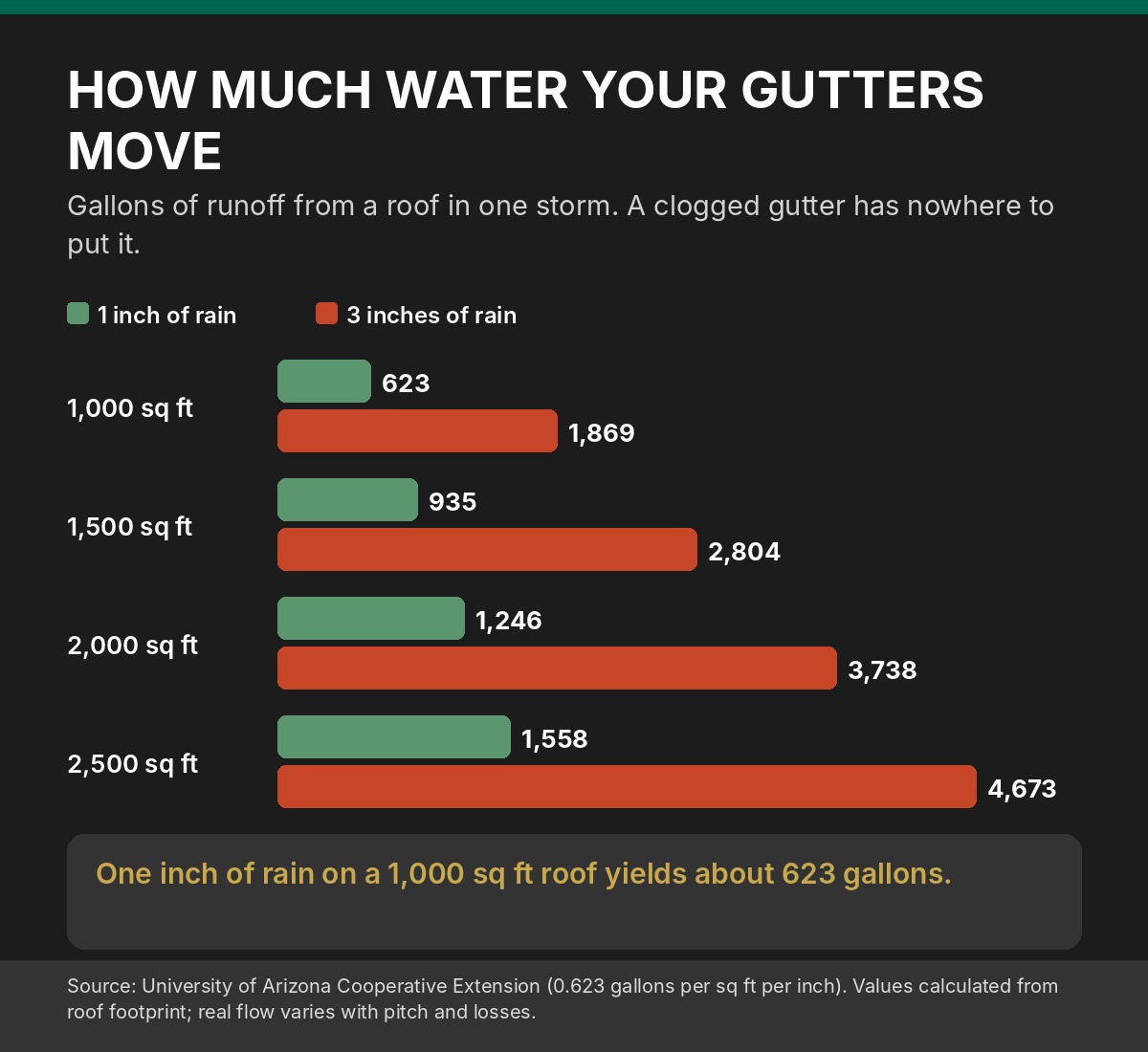
A roof sheds far more water than most homeowners picture. The University of Arizona Cooperative Extension puts roof runoff at 623 gallons per inch of rain on every 1,000 square feet of roof. A three-inch storm on a 1,500 square foot roof sends roughly 2,800 gallons toward the gutters, which is why a partly clogged gutter is a real liability.
What Are the Pros and Cons of Gutter Guards?
The main pros of gutter guards are fewer clogs, less cleaning, fewer ladder climbs, and better protection for fascia and foundation. The main cons are upfront cost, water overshooting some guard types in heavy rain, and the fact that guards still need occasional cleaning.
| Pros | Cons |
|---|---|
| Far fewer manual cleanings and ladder climbs | Higher upfront cost than open gutters |
| Less standing water and debris for pests | Cheap or mismatched guards can overshoot in downpours |
| Slower corrosion from wet, packed debris | Fine grit and needles can bypass low-quality screens |
| Free-flowing water away from the foundation | Guards still need rinsing and inspection |
Fewer Ladder Climbs
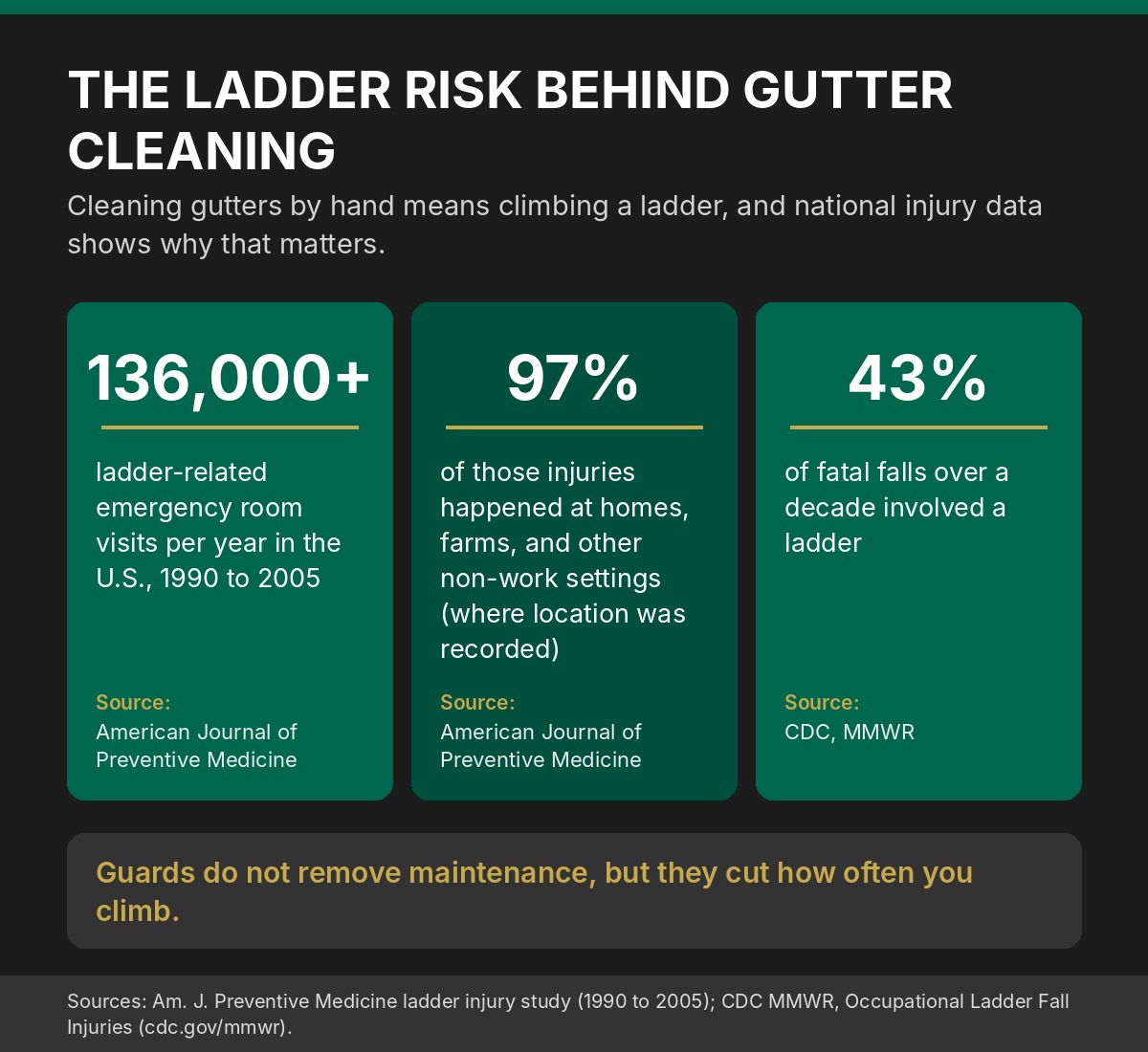
Cleaning gutters by hand means climbing a ladder, and that carries real risk. The Centers for Disease Control and Prevention reports that 43 percent of fatal falls over a decade involved a ladder, and a national study in the American Journal of Preventive Medicine found about 136,000 ladder-related emergency room visits per year, with the large majority happening in non-work settings. Guards cut how often you climb, though not to zero.
Pest Control and Gutter Life
Open gutters packed with wet leaves hold standing water, and mosquitoes lay eggs in standing water. The CDC advises routinely emptying water from sources such as clogged rain gutters to avoid helping mosquitoes breed, as noted in its mosquito prevention guidance. A well-fitted guard also keeps nesting birds and rodents out, and a drier trough corrodes more slowly.
How Do Different Types of Gutter Guards Compare?
Micro-mesh blocks nearly all debris, including pine needles. Surface-tension guards shed large leaves and handle heavy flow. Foam, brush, and basic screens cost less but clog or collapse more easily. Each trade-off in debris handling, maintenance, and lifespan makes some types better for certain yards.
| Guard Type | Best For | Strength | Weakness |
|---|---|---|---|
| Stainless steel micro-mesh | Pine needles, fine debris | Blocks needles and grit, long life | Highest cost, needs correct pitch |
| Surface-tension (reverse curve) | Large leaves, heavy rain | Sheds leaves, durable | Can overshoot if pitched wrong |
| Foam inserts | Short-term, low budget | Cheap and easy to fit | Traps silt, grows moss, degrades |
| Brush guards | Large, dry leaves | Low cost, easy to fit | Needles wedge in bristles |
| Plastic or metal screens | Minimal protection | Low cost, blocks big leaves | Collapses under snow or debris |
Premium Options: Micro-Mesh and Surface-Tension Guards
Stainless steel micro-mesh has openings small enough to stop silt, grit, and pine needles while still passing water. It costs more and works best when a professional sets the fit and pitch. Surface-tension guards route water around a curved nose and let leaves slide off, but Consumer Reports testing found that this style struggled in a severe downpour, so pitch and gutter size matter. A properly installed premium system can outlast the gutters beneath it.
Budget Options: Foam, Brush, and Screen Guards
Foam inserts block water as well as debris, and their open-cell structure holds silt and seeds, which can grow moss and crumble in sunlight. Consumer Reports found that inserts such as foam and brush were not good at keeping debris out. Brush guards catch large dry leaves but trap needles in the bristles. Basic screens stop big leaves for little money, then buckle under snow or heavy debris.
What Is the Best Gutter Guard for Pine Needles and Oak Leaves?
The best gutter guard for pine needles is stainless steel micro-mesh, because needles cannot pass through its tiny openings. For large oak leaves and maple seeds, a surface-tension guard works well because wind clears leaves off the curved surface.
Solving the Pine Needle Problem
Pine needles are the hardest test for any guard. They are thin and rigid, so they slip through standard screens or wedge into brush bristles. A basic plastic screen under a pine often packs with needles in one season. Micro-mesh keeps needles on top, where they dry and blow off, though heavy rain can sheet over the mesh and the surface still needs a seasonal rinse.
Handling Oak Leaves and Seed Clusters
Wet oak leaves mat together and can cover a guard, and spring tassels and seed clusters add a second debris wave many owners do not expect. Surface-tension designs keep channeling water even when the top is partly covered. Walk your property and identify the trees overhead before choosing a guard, because species decides which type fits.
What Are the Most Common Gutter Guard Installation Mistakes?
Common gutter guard installation mistakes include sliding guards under shingles, setting the wrong pitch, mounting over damaged gutters, and using weak fasteners. Each one can cause overflow, void a roofing warranty, or shorten the life of the system.
- Altering shingle placement: Some guards slide under the first shingle course, which can affect the roof manufacturer’s warranty. Confirm the installation method with your roofer first.
- Wrong pitch: Too flat and debris piles up, too steep and water overshoots the gutter in heavy rain.
- Installing over damaged gutters: A guard performs only as well as the gutter below it, so sagging or rusted gutters need repair first.
- Weak fasteners: Tape or plastic clips often fail within a season or two under sun, ice, and wind.
Why an Inspection Comes First
A pre-installation inspection confirms the gutters can support a guard and identifies the roof pitch and gutter size that decide which type will perform. If the gutters are aging sectional runs with many joints, a continuous replacement may beat adding guards to a worn system. A documented roof inspection also checks the shingle edge and fascia where guards attach.
Ice Dams, Winter, and Roof Ventilation
Guards do not cause ice dams on their own, but a poor pitch can trap meltwater at the edge. The real safeguards are attic insulation and balanced attic and roof ventilation, not removing guards each fall.
Do Gutter Guards Still Need Maintenance?
Yes. Guards reduce maintenance but never end it, because pollen, roof grit, and silt still build up. Plan on a seasonal rinse and a quick check after major storms, and treat the “never clean again” pitch with caution.
- Spring: rinse the surface and clear seed clusters and tassels
- Fall: brush off leaf cover and check that water enters the gutter freely
- After storms: look for overflow marks, sagging, or loose sections
Skipping inspections for years is how guards fill with decomposed material and perform worse than open gutters. Professional gutter cleaning and repair keeps the whole system working between your own rinses.
Gutter Guard FAQs
Which brand of gutter guard is best?
No single brand is best for every home. The right choice depends on your debris type, roof pitch, gutter condition, warranty terms, and installer quality. Compare guard type and installation method before comparing names.
What is the average cost to install gutter guards?
According to Angi, materials run about $1 to $10 per linear foot and professional installation adds about $9 per linear foot on average. Totals vary with guard type, gutter length, roof height, and gutter condition.
Should you remove gutter guards in the winter?
Generally no. Quality guards are built for winter weather, and removing them each fall defeats their purpose. Proper attic insulation and ventilation do more to prevent ice dams than seasonal removal.
What problems can gutter guards cause?
Common issues include debris building on top, water overshooting in heavy rain, and difficulty cleaning beneath a guard when fine silt gets through. Most trace back to a mismatched guard type or poor installation, not the product category itself.
Do roofers recommend gutter guards?
Many do, with conditions. Guards can cut cleaning meaningfully, but installations that alter shingle placement or attach to compromised gutters can cause more problems than they solve. Be cautious of anyone who recommends the same guard for every home.
Are cheap gutter guards worth it?
Rarely as a long-term fix. Foam and brush inserts tend to clog and degrade, and basic screens collapse under load. They can serve as a short-term stopgap while you budget for a better system.
Can gutter guards go on any gutter?
Only on gutters that are sound. Sagging, rusted, or improperly sloped gutters should be repaired or replaced before any guard goes on, since the guard cannot fix a water-flow problem underneath it.
Get an Honest Look at Your Gutters
For most homes with mature trees, a well-chosen, properly installed guard is a sound investment, as long as you expect occasional rinsing and the gutters beneath are in good shape. If the gutters are sagging or corroded, solve that first.
The team at Tip Top Roofing will examine your roof and gutters, lay out your repair and replacement options, and let you make the final call, with no pressure and no upsell for a system that does not fit. Request a gutter evaluation or call (336) 922-3325.